"Through Hispanic Eyes" and "Through Hispanic Eyes@ Workshop" are two distinct programs designed for institutional leaders who are interested in improving the conditions for Latine/Hispanic students and colleagues at their institutions.
Through Hispanic Eyes
T.H.E Program Description
Through Hispanic Eyes (T.H.E) is a cultural competency training program for higher education that the HSP has facilitated for over two decades. Participants in this program are institutional leaders who come together to learn about higher education insights from Latine/Hispanic leaders and the particularities of the Latine/Hispanic experience in university and seminary programs. This program overlaps with our Summer Session program so T.H.E participants have the opportunity to engage graduate students in higher and theological education from across institutional contexts. Participants consistently report our T.H.E program as among the most helpful and meaningful programs in which they have ever participated.
Program Dates and Location
Date: Details forthcoming
Location: Details forthcoming
Program Fee
$750 for participants
The program fee includes the cost of room, board, travel, and all program activities including facilitation
Program Eligibility
This program is open to institutional leaders, which we define as faculty members, staff members, and/or administrators from HSP Sponsoring Schools
Program Testimony
“Wartburg Theological Seminary is a proud supporter of the Hispanic Scholars Program. In addition to the positive experiences our students have had in the various course offerings, I am an alum of Through Hispanic Eyes, one of the signature programs of the HSP. It was such an informative, constructive program for me, not only because I learned a great deal about the past and current context of Latine theological education, but also because as Wartburg seeks to become more welcoming and hospitable to Latine students, it was really insightful to hear first-hand from those who have experienced that context from the inside. Finally, I can’t say enough about the networking and the personal connections I made. In theological education, we are better together as institutions, and so to be able to build bridges with other institutions and other individuals, particularly those who come out of a Latine background, was a fantastic experience for me. I highly recommend Through Hispanic Eyes as a program and strongly encourage support of the Hispanic Scholars Program in general.” – Kristin Johnston Largen
Program Application
The application for this program has closed for the 2026 Through Hispanic Eyes
When Will I Receive My Admission Decision?
Applicants will typically receive an email notification regarding the status of their application within two weeks of the application closing
heir program admission. This matriculation form includes the process for paying the Program Fee and is due 2 weeks after the notification of admission.
The HSP accepts the following payment methods for the Program Fee after an individual has been accepted into the program:
Check: Please make checks payable to the Hispanic Scholars Program and mail to: Hispanic Scholars Program (42 Tiemann Place, Ste 310 New York, NY 10027)
PayPal: Payments may be submitted via PayPal using an existing account or by creating one and linking your credit card
Zelle: Zelle payments may be made to admin@hispanicscholarsprogram.org
Please contact the HSP administrator, Elizabeth Niang (eniang@hispanicscholarsprogram.org), if you have any questions regarding payment options.
Travel: After you have been officially accepted to the program, submitted your matriculation form, and submitted the program fee, you may proceed with purchasing your travel to the program location. Upon purchasing your travel, you must submit your full travel itinerary via email to the HSP administrator, Elizabeth Niang (eniang@hispanicscholarsprogram.org).
Housing: All housing for the duration of the program is coordinated directly by the HSP. We recognize that travel schedules may require some participants to arrive prior to the program start date or depart after the program concludes. If you require housing outside of the official program dates, we will work with you to coordinate accommodations. Please note that the cost of any additional housing will be deducted from your travel reimbursement.
Since its first Summer Session in 1989, the Hispanic Scholars Program (HSP) has sought to be a place of welcome in which theological education is made available to all students. In keeping with this commitment, the HSP does not discriminate in its admissions or program practices on the basis of race, ethnicity, national origin, gender, disability, or any other status protected by law. Applicants are evaluated using program-related criteria such as academic preparation, vocational interest, character, and commitment to theological study. The HSP has always served students, faculty, staff, administrators, and leaders from a wide range of backgrounds. Guided by the values of en conjunto (working together as a community), lo cotidiano (attending to the realities of daily life), and acompañamiento (walking alongside one another), we affirm that all people are created in the image of God and journey together in learning and faith.
Through Hispanic Eyes Facilitators
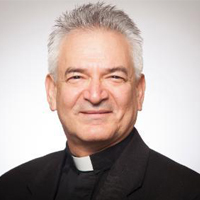
Rev. Dr. Eduardo Fernández, S.T.D.
Rev. Dr. Eduardo Fernández, a member of the Society of Jesus, is Emeritus faculty from the Jesuit School of Theology of Santa Clara University and the Graduate Theological Union in Berkeley, where he taught courses such as “Church, Mission and Cultures”; “Intercultural Ministry: Parish, Campus, and Classroom”; “Latino/a Theology Seminar”; “Decolonizing Mission”; and “Theology and Ministry in the Age of Migration.” He specializes in Latiné theology, Mexican and U.S. History of the Southwest, social justice, inculturation, and the celebration of sacraments in intercultural contexts.
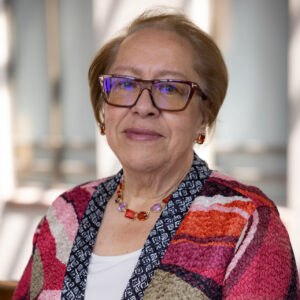
Rev. Dr. Daisy L. Machado, Ph.D.
Rev. Dr. Daisy L. Machado, a native of Cuba, was raised in NYC. She is ordained in the Christian Church (Disciples of Christ), is Emerita faculty from Union Theological Seminary in NYC where she also served as Academic Dean, the first Latina to hold this position. Trained as an historian, she earned her doctorate from the Divinity School at the University of Chicago, her M.Div. from Union Theological Seminary, her M.S.W. from Hunter School of Social Work, and her B.A. from Brooklyn College. Her writings include a focus on the U.S. borderlands, Prosperity Gospel, heterotopic saints, lived religion in the borderlands, and Protestant missions to the U.S. borderlands. Rev. Dr. Machado has been leading border immersion trips since 1997 helping students connect to this heterotopic region where life is truly lived in the margins. She previously served as Executive Director of the Hispanic Scholars Program from 2013-2026.
Through Hispanic Eyes@ Workshop
On Site Workshops and Immersion Experience
2026 – 2028
T.H.E@ Workshop Overview
For over two decades. Through Hispanic Eyes (T.H.E.), one of our flagship programs, has met the critical needs of non-Latiné faculty and staff to better understand the Latiné community by inviting their participation in a workshop held in June during the Summer Session. In recent years, sponsoring institutions have asked us to flip the model and bring T.H.E. to them. The launch of T.H.E.@ is our answer to these requests, offering on-site programming directly at partner institutions.
T.H.E@ Workshop Schedule
The T.H.E.@ onsite workshop will be offered four times between Fall of 2026 and Spring 2028, each held at a different partner school’s campus thereby providing four sponsoring schools an opportunity to participate in the workshop, one school per semester. Each school will choose one of the two dates offered for the workshop (see below) which works best for their faculty/staff. Due to the complexity of planning the border immersion, the dates for the trip cannot be changed.
Participation is limited to ten (10) non-Latiné faculty and administrators (academic deans, deans of students, admissions officers, etc.)
The workshop concludes with a border immersion trip, and it is expected that all participants in the workshop will commit to attending. There is no better way to learn about and experience what has been shared and discussed in the workshop than to travel to those locations where the workshop themes are embodied in the people and places to which the participants will visit. All participants must have a valid U.S. passport.
Schedule of On-Campus Workshops
Fall 2026: October 7, 8, 9 OR November 4, 5, 6 (choose one date) with the Immersion Trip: January 10 – 14, 2027
Spring 2027: March 10, 11, 12 OR April 7, 8, 9 (choose one date) with the Immersion Trip: May 16 – 20, 2027
Fall 2027: October 6, 7, 8 OR October 13, 14, 15 (choose one date) with the Immersion Trip: January 9 – 13, 2028
Spring 2028: March 22, 23, 24 OR March 29, 30, 31 (choose one date) with the Immersion Trip: May 14 – 18, 2028
Borderlands Immersion Trip (Tentative Schedule)
Day One: Arrival
Day Two: Borderlands Life – Community and Hope
Day Three: The Border: A View from Both Sides
Day Four: Religion and Healing in the Borderlands
Day Five: Return Home
T.H.E@ Workshop Fee
This workshop is $5,000 for both on-campus workshop and the border immersion trip.
Key Takeaways
Transformative Two-Day Faculty Workshop (On Campus): Engage your institution’s non-Latiné faculty/staff in an immersive, in-person professional development experience led by experienced Latiné scholars and administrators. Participants will have the opportunity to deepen their understanding of Latiné communities, critically evaluate their syllabi for inclusive representation, and reimagine their teaching and/or administrative work through a Latiné theological lens. Faculty and staff will also be invited to discuss how their school can develop a new pedagogical and administrative roadmap to produce competent religious leaders prepared to serve as visionary change agents in their communities.
Five-Day Borderlands Immersion Experience (U.S.-Mexico Border, Texas): Participants will travel to the U.S.–Mexico border for a powerful immersion learning experience. Through guided encounters and reflection, participants will explore critical issues such as migration, belonging, community organizing, women’s rights, ecological issues, and class—gaining insights that directly inform and enrich their teaching and administrative work with students.
Exceptional Value With Significant Subsidy: Through the generous support of the HSP, your institution receives a program valued at $55,000 for a fee of just $5,000.
Cohort-Based Participation: Up to ten faculty members and administrative staff that work with student services (dean of students, admissions, etc.) from your institution can take part, fostering both shared learning and long-term institutional impact.
Why This Matters Now
Latiné communities are among the fastest-growing populations in the United States, representing over 20% of the total national population. They also demonstrate some of the highest levels of religious and spiritual engagement across racial and ethnic groups. Yet many faculty/staff in seminaries and divinity schools lack the tools to prepare graduate students for meaningful ministry within these communities. This program is designed to bridge that gap, equipping faculty/staff with the insight, skills, and frameworks needed to respond to this critical opportunity.
T.H.E@ Workshop Contact
For more information and to express interest in bringing T.H.E. @ to your institution, please email Elizabeth Niang at eniang@hispanicscholarsprogram.org.
Through Hispanic Eyes@ Workshop Program Director
Rev. Dr. Daisy L. Machado, Ph.D.
Rev. Dr. Daisy L. Machado, who is ordained in the Christian Church (Disciples of Christ), is Emerita faculty from Union Theological Seminary in NYC where she also served as Academic Dean. Trained as an historian, she earned her doctorate from the Divinity School at the University of Chicago. Her writings include a focus on the U.S. borderlands, prosperity gospel, heterotopic saints and lived religion in the borderlands, and Protestant missions to the U.S. borderlands. Rev. Dr. Machado has been leading border immersion trips since 1997 helping students connect to this heterotopic region where life is truly lived in the margins. She previously served as Executive Director of the Hispanic Scholars Program from 2013-2026.
Through Hispanic Eyes@ Workshop Leaders
Dr. Jonathon Calvillo, Ph.D.
Dr. Jonathan Calvillo, trained in Sociology of Religion, examines how distinct Latiné populations build communities of belonging through faith and creativity, often in the face of systemic exclusion. His current projects focus on how churches shape Latiné civic engagement, how lived religion influences Latiné ethnoracial identities, and how young Latiné creatives have responded to urban inequalities through artistic resistance.
Rev. Dr. Gregory L. Cuéllar, Ph.D.
Gregory L. Cuéllar, Ph.D., is Full Professor of Hebrew Bible and Ruth A. Campbell Professor of Biblical Studies at Austin Presbyterian Theological Seminary. He co-chairs the European Association of Biblical Studies Research Unit “Museums and the Bible” and co-founded the Arte de Lágrimas: Refugee Artwork Project. His books include Empire, the British Museum, and the Making of the Biblical Scholar in the Nineteenth Century (Palgrave 2019), Resacralizing the Other at the U.S.–Mexico Border: A Borderland Hermeneutic (Routledge 2020), and Migration and Western Biblical Interpretation: Empire, Method, and the Politics of Displacement (Brill 2026). His research explores postcolonial biblical interpretation, migration, and museum studies.
Dr. Teresa Delgado, Ph.D.
Dr. Teresa Delgado is Dean of St. John’s College of Liberal Arts and Sciences and professor of theology and religious studies at St. John’s University, NY. She received her doctorate from Union Theological Seminary (NYC), under the guidance of the trailblazing womanist theologian Dr. Delores S. Williams. She has published on topics ranging from decolonial theology, diversity in higher education, transformational pedagogies, constructive theology and ethics, and justice for racially, ethnically and sexually minoritized persons.
Rev. Dr. Leslie Díaz-Pérez, D.Min.
The Rev. Dr. Leslie Díaz-Pérez is the Senior Director of Admissions & Enrollment and Director of El Centro at McCormick Theological Seminary. This is the place where she helps shape the future of theological education through recruitment strategy, program development, and partnerships that expand access for diverse communities. She brings decades of experience from the classroom to the pulpit, bridging cultures, generations, and abilities.
Ms. Caly Fernández
Ms. Caly Fernández is a lay leader in the UPCUSA and has been working as a community organizer in the Río Grande Valley in South Texas. Her work brings her into contact with vulnerable communities, especially women and children, where her advocacy and organizing skills keep her in close contact with and connected to those many other community organizations and projects that work for justice, inclusion, access to food, education, health, as well as ecological concerns.
Rev. Dr. Eduardo Fernández, S.T.D
Rev. Dr. Eduardo Fernández, a member of the Society of Jesus, is Emeritus faculty from the Jesuit School of Theology of Santa Clara University and the Graduate Theological Union in Berkeley, where he taught courses such as “Church, Mission and Cultures”; “Intercultural Ministry: Parish, Campus, and Classroom”; “Latino/a Theology Seminar”; “Decolonizing Mission”; and “Theology and Ministry in the Age of Migration.” He specializes in Latiné theology, Mexican and U.S. History of the Southwest, social justice, inculturation, and the celebration of sacraments in intercultural contexts.